Why Boxing Belongs in a Preppers’ Skill Set
Physical preparedness is an often-overlooked part of emergency readiness. Fatigue, stress, limited mobility and elevated heart rate can all affect decision-making and safety during real survival situations.
Boxing fits naturally into a prepper skill set because it develops practical conditioning and movement under pressure without requiring complex systems or specialized equipment. It is accessible to beginners, scalable to different fitness levels and proven in environments where tension and exhaustion are the norm.
While boxing is not a complete self-defense solution and does not address every threat, it builds valuable fundamentals like awareness, balance, controlled striking and efficient movement.
And it’s so much more than Rocky and Apollo. Here we’ll focus on how boxing supports personal safety and prepares for crisis scenarios, not glory in the ring, when conditions are less than ideal.
Benefits and Weaknesses of Boxing for Preppers
I. Key Benefits
One of boxing’s strongest benefits is cardiovascular conditioning under stress. Training rounds create fatigue, elevated heart rate and limited recovery time. This is what happens during emergencies. Boxing prepares you for functioning while tired and winded.
Boxing also develops hand-eye coordination and reaction speed. Responding to movement, tracking targets and timing actions are skills that transfer well to many real-world tasks.
Footwork and balance are emphasized from day one, reinforcing stability and controlled movement rather than brute force.
Another major advantage is simplicity. Boxing uses a limited set of techniques, making it easier to retain under duress. When adrenaline spikes, simple skills are more likely to remain accessible than complex systems.
II. Key Weaknesses and Limitations
Boxing has clear limitations. It does not include:
- Kicks
- Grappling
- Ground defense
It also offers limited solutions against weapons. Sport rules, such as glove use and time limits, do not translate perfectly to real emergencies.
Additionally, boxing emphasizes head-level striking, with contact while sparring … protective equipment is necessary when training. It also reinforces the need for caution and controlled training.
III. Prepper Hint
For preppers, boxing works best as a foundational striking skill and a conditioning and movement base. It is most effective when supplemented with other preparedness skills rather than relied on exclusively.
Boxing Training Methods Preppers Can Use Anywhere
I. Shadowboxing
Shadowboxing is one of the most versatile boxing tools available. It builds movement, visualization and technique without requiring any equipment. Practicing footwork, defensive movement and basic punches in the air allows preppers to train in limited space and in grid-down situations.
Shadowboxing also reinforces situational awareness by encouraging intentional movement and posture. (This is an essential prepper skill. Get an in-depth overview on situational awareness here).
It is easy to scale intensity up or down depending on fitness level and environment.
II. Heavy Bag Training
Heavy bag work develops power, distance management and conditioning. For preppers training at home, a bag provides resistance and feedback without needing a partner. Emphasis should remain on controlled strikes and proper form rather than wild swings, which increase injury risk. (Wrap your hands to help protect them from the force of hitting the bag.)
Bag rounds can also create fatigue and stress by structuring work and rest periods, reinforcing endurance and discipline.
III. Focus Mitts
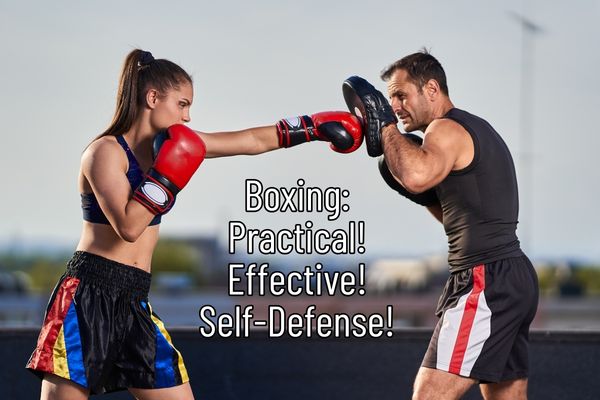
Focus mitt training improves timing, accuracy and reaction speed. Working with a partner or coach introduces movement and unpredictability, which helps simulate reacting to a dynamic situation. Even basic mitt drills reinforce coordination and controlled engagement.
IV. Jump Rope
A jump rope is one of the most prepper-friendly conditioning tools available. It improves footwork, stamina and coordination, while being extremely portable and low maintenance. A rope can be packed, stored or replaced easily.
V. Sparring (Optional but Valuable)
Light, controlled sparring introduces a stress booster. It teaches how to remain functional while facing resistance and unpredictability. For safety, sparring should remain technical and controlled, prioritizing learning over dominance.
Boxing Strategy and Its Value in Emergency Defense
I. Managing Distance and Angles
Boxing places heavy emphasis on distance control. Staying just outside an opponent’s reach reduces risk while preserving options. Lateral movement, rather than backing straight up, helps avoid obstacles and maintains balance.
II. Creating Openings
Boxing strategy uses feints and light strikes to provoke reactions. Drawing attention high or wide can create brief openings that allow repositioning or disengagement. This is about building opportunities, not trading damage.
III. Economy of Motion
Efficient movement is critical during emergencies, where adrenaline drains stamina quickly. Boxing trains short, efficient actions that conserve energy and reduce unnecessary exposure.
IV. Defensive Awareness
Defensive habits such as head movement, guard positioning and constant repositioning reinforce awareness. Boxing discourages standing still and absorbing damage, instead emphasizing avoidance and movement.
V. Prepper Hint
For preppers, strategy matters more than raw power. Boxing teaches thinking while moving, which supports decision-making under pressure rather than impulsive reactions. More great info on decision-making under pressure here.
Core Boxing Techniques That Support Strategy
I. Primary Punches
- The jab is a range-finding and control tool, useful for managing distance and maintaining awareness.
- The cross delivers straight-line power with efficiency.
- Hooks are effective at close range.
- Uppercuts function well in tight spaces.
These punches are simple, direct and adaptable, making them easier to recall under stress.
II. Defensive Movements
- Slipping punches
- Bobbing and weaving
- Simple parries
These reinforce avoidance rather than absorption and the movements emphasize posture, balance and awareness.
III. Clinching
Clinching is often misunderstood. In practical terms, it allows brief control, disrupts rhythm and creates space. For preppers, the goal is disengagement rather than prolonged struggle.
IV. Combinations
Combinations matter because they reinforce flow and movement, as well as encourage follow-through and repositioning.
Examples include jab to cross, jab to hook, or jab, slip, cross. These are conceptual patterns that keep your opponent off guard and give you an advantage when they land.
Applying Boxing Skills to Real-World Emergency Scenarios
In a true survival situation, preppers think avoidance, escape and defense, not winning fights.
I. Situational Awareness
Boxing reinforces awareness by teaching posture, balance and readiness. Recognizing potential threats early allows preppers to reposition or disengage before situations escalate.
II. Striking to Create Opportunity
In emergencies, strikes should be used to break contact, create space and enable escape. The objective is not prolonged engagement, but regaining freedom of movement.
III. Movement and Positioning
Boxing footwork helps avoid corners and obstacles. Keeping hands up while moving reinforces protection without freezing in place.
IV. Stress Management
Breathing control and familiarity with elevated heart rates help manage adrenaline. Boxing teaches that panic wastes energy, while controlled movement preserves function.
V. Legal and Safety Considerations
Self-defense laws vary by location. Preppers should emphasize proportional response and disengagement whenever possible. Training should always prioritize safety and legal awareness.
Boxing Tools and Equipment for Preppers
I. Essential Gear
- Hand wraps help prevent injury and support the wrists
- Gloves provide protection during training
- A jump rope supports conditioning and footwork
II. Training Equipment
- A heavy bag allows home-based training
- Focus mitts support partner drills.
Both are durable and require minimal maintenance.
III. Optional Support
- A coach or structured program can accelerate learning and reduce bad habits.
- Community gyms offer instruction and accountability, while solo training offers flexibility.
IV. Prepper Hint
Most boxing gear is affordable, durable and low maintenance. It aligns well with preparedness principles of simplicity and sustainability.
Is Boxing Right for You as a Prepper?
Boxing is well suited for beginners to experts and those focused on fitness combined with basic self-defense skills. It is especially useful for preppers who want conditioning, movement and stress tolerance without heavy equipment.
It is less suited for weapon-heavy threat environments or scenarios that involve prolonged ground fighting. For most preppers, boxing works best as a starting point rather than an endpoint. It provides a strong foundation that can be expanded with other skills as needed.
Common Boxing Mistakes Preppers Make
- Training only for power, not endurance. Heavy punches feel useful, but fatigue sets in fast under stress. Don’t underestimate conditioning, breathing and pacing.
- Ignoring footwork and positioning. Standing still or squaring up too much increases risk. Movement, balance and angle control matter far more than trading punches.
- Practicing flashy combinations instead of fundamentals. Complex combos break down under adrenaline. Simple jabs, guards and exits are more reliable in emergencies.
- Neglecting defensive skills. Many focus on hitting rather than protecting. Head movement, guarding and awareness are critical for injury avoidance.
- Training only in a gym setting. Real environments are uneven, crowded and unpredictable. Never adapting training to confined or outdoor spaces limits usefulness.
- Letting ego drive sparring. Hard sparring “to prove toughness” leads to injury and burnout. Longevity and consistency are far more important.
- Failing to integrate escape mindset. Boxing conditions preppers to stay and fight, but survival often means disengaging and leaving as soon as possible.
Key Boxing Takeaways for Preppers
Boxing offers more than just striking skills. It develops practical habits that translate well to high-stress, real-world situations. For preppers, its value lies in how it sharpens the body and mind for movement, decision-making and survival when conditions are unpredictable.
The following takeaways highlight why boxing can be a useful piece of a broader preparedness plan.
- Boxing builds endurance under stress
- Simple techniques are easier to recall in emergencies
- Movement and awareness matter more than power
- Boxing works best when paired with other skills
- Equipment requirements are minimal
- Training can be done almost anywhere
- Conditioning supports overall preparedness
- Strategy and restraint matter more than aggression
- Escape and survival are the priority
Frequently Asked Questions
- Is boxing effective for real-world self-defense?
Boxing is effective for building movement, awareness and striking fundamentals. It is not a complete self-defense system, but it provides transferable skills that support escape and defense.
- Can boxing help against larger attackers?
Boxing emphasizes angles, distance and efficiency rather than size alone. While no system guarantees outcomes, these skills can help manage space and reduce risk.
- Is boxing safe to train without a gym?
Yes, many aspects of boxing can be trained safely at home with proper technique and protective equipment. Shadowboxing and conditioning are especially accessible.
- How long does it take to gain useful skills from boxing?
Basic benefits such as conditioning, footwork and awareness can develop within a few months of consistent training.
- Does boxing work in confined spaces?
Boxing techniques emphasize compact movement and balance, which can be useful in tighter environments. However, awareness of surroundings remains critical.
- What are boxing’s biggest limitations for preppers?
Boxing does not address weapons, grappling or ground defense. It should be viewed as a component of preparedness, not a standalone solution.
- Should boxing be combined with other preparedness skills?
Yes. Boxing pairs well with situational awareness training, physical conditioning, first aid knowledge and de-escalation skills for a more balanced approach.
This article is provided for informational and educational purposes only. It does not constitute self-defense, fitness, or training advice. Boxing and physical training involve inherent risks. Readers are encouraged to seek instruction from qualified boxing coaches or martial arts professionals and to take responsibility for their own training decisions.