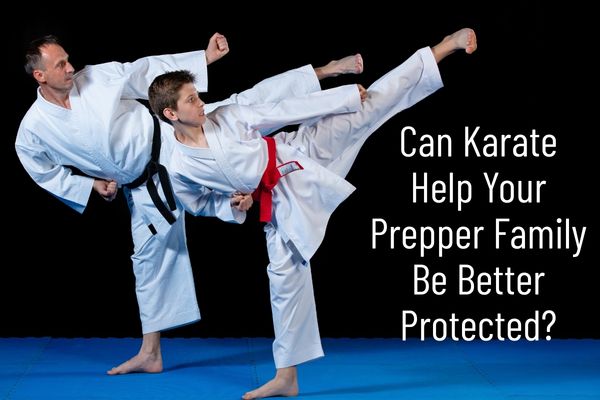
All preppers are concerned about security and protection. But just how do preppers learn to protect themselves, their families, and their possessions.
Previously we looked at boxing as a self-protection art. But what about Karate? What does karate do well that can help keep you safe … and what might be some of its weak points?
How karate’s origins could help preppers today.
Karate’s origins are hundreds of years old. The Okinawan people developed it to protect themselves against armed Japanese samurai. As originally created, it’s a complete fighting system with punching, striking, low kicks, choking, joint locks, and throws. Not flashy, but effective.
Karate is still an effective martial art, but what’s important is who’s teaching you. I started training in Shorin-Ryu karate in 1972 and realized after years of training that my first teacher didn’t have a full understanding of karate’s self-defense methods.
How karate can prepare you to protect yourself.
First, let’s talk about kata. Kata are “formal exercises” … choreographed movements … that teach the combat system. I think of kata as part dictionary and part encyclopedia. They reveal how karate works for self defense. But it’s clear to me that some karate teachers understand forms better than others.
I’ve found that practicing kata can build endurance, agility, strength, mental toughness, and flexibility. And if the prepper has a good instructor, it can help develop understanding of karate’s fighting techniques.
Let’s look at a few specific karate techniques
Examining how some sensei understand (or don’t understand) their art’s techniques will help you determine if they are the right teacher for you.
There’s a karate technique called Age Uke (upper block or rising block). Imagine you’re holding a nail while hanging a picture. The arm being used to hold the nail is in the basic position found at the end of the technique. Some karate teachers will explain this as an upper block … protecting your head from a straight punch or a roundhouse punch. And it could be used for that.
But a karate teacher who understands self-defense will also explain how the forearm in this technique could be used to strike an opponent. This turns the upper block into an offensive technique. It took me years of training before I found a teacher who understood this.
Next, let’s look at Gedan Bari (downward parry). My first karate teacher described this technique as a defensive maneuver that blocks attacks aimed at your chest to your groin. But it can do more than that. It took me more than a decade of research to realize it can also be used to break an opponent’s elbow or escape a wrist grab.
Other karate training methods for self-defense readiness
Ippon Kumite: Here a karateka (karate practitioners) delivers one offensive technique and allows the partner to defend against it. This gives students the chance to practice against a person, creating more pressure.
Free Sparring: Here’s where karate students get to truly test their ability. Sparring allows you to attack and defend in a live situation. It’s important to wear proper protective gear to stay injury free. Sparring is about as close as it gets to testing whether you’re ready to defend yourself.
Makiwara Training: Karateka hit a wooden post wrapped in a rough twine. Punching and striking this post develops muscle strength, technique, and hardens the hands and arms to deliver a real strike to an opponent.
Does the style of karate you practice matter?
There are many karate styles and they’re equally good. What matters more is the specific teacher and whether he or she understands their style.
Here’s a short list of styles and what they’re most known for …
Kyokushin: If you’re not afraid of getting hit (or if you feel that’s a necessary part of training), this might be the style for you. This style is known for its tough training and contact sparring.
Goju-ryu: This translates to the school of hard and soft (flexible). This is a balanced style that brings together linear techniques with circular movements for a well-balanced approach.
Shorin-ryu: Shorin is the way Okinawan people pronounce Shaolin. So, this style has its roots in Kung Fu and the Shaolin Temple. Often Shorin-ryu stylists put more emphasis on speed and circular (more fluid) movements.
Shotokan: This popular style is known for its long and deep stances. It focuses on explosive, linear power. Shotokan stylists are known for keeping their distance from opponents and developing the power to end a conflict with one shot.
My personal favorite fighting style is Kyokushin, but the training is tough.
Watch out for these mistakes when looking for a school and teacher
Picking a school for convenience: Choosing a school just because it’s close to home or because it’s the cheapest is not a good strategy. Convenience alone does not make the school a good fit. Instead, choose a school that focuses on real world effectiveness.
Focusing on fantasy and not the reality of martial arts: Some start a karate program with fantasies of fending off 10 assailants without getting a scratch. That’s not realistic. Also, real karate training is not like the movies. (I’ve had many students quit because the hard work and grinding repetition does not match their fantasies.)
Being focused on your rank (belt color) and not your skills: Don’t worry about your belt color. Worry about your skills. There are a lot of hard-working yellow belts that could give a lazy black belt a hard time.
Expecting instant success: Allow yourself the chance to be bad. It’s the mistakes you’ll make that will teach you the proper methods. Every skilled karate student was terrible the first day they walked into a school. So, have the patience to allow your skills to grow as you train.
Five training tips to get you started right …
Here’s a little advice I give to all starting students. (1) Practicing three times a week should be enough, but practicing more won’t hurt. (2) Fundamentals matter, so master the basics. (3) Don’t let yourself feel overwhelmed or intimidated; see this as an adventure. (4) Take warm up exercises seriously, because they’ll help prepare you for success. (5) Stay curious, because there’s always something new to learn.
FAQs (Frequently Asked Questions)
How long will it take to acquire the skills to protect myself?
That depends on your ability and the school’s teaching methods. It takes at least a year before most students can build some competency. And it usually takes a student about six years to earn a black belt.
Will karate teach how to defend against multiple attackers?
Karate helps even the odds, but that’s it. It can help a shorter or older person against a taller, stronger attacker. It can help a woman defeat a man. It can help a strong, capable person against two attackers. But don’t believe movie hype. A skilled karate stylist probably won’t win against multiple attackers.
Do you have to be in great shape to start karate?
A skilled teacher can take a student where they are and develop the right skills and attributes (like strength, speed, and endurance). All you need is the desire and determination to work hard.
Is there a better martial art than karate that I should study?
There are no better styles, just better teachers. So, look for a teacher that understands their style. Do the research to determine what style best suits your athletic abilities and personality.
Does karate only teach kicking and punching or is there more to it?
Karate, as taught by old school masters in Okinawa, was a complete martial system incorporating joint locks, grappling, choking, and throwing techniques. But not all teachers understand karate’s full range. Ask questions to determine what depth of understanding a teacher has.
This content is provided for informational and educational purposes only. It does not constitute professional training, legal, or medical advice. Martial arts training carries inherent risks, and results vary depending on the individual, instructor, and training environment. If you’d like to learn martial arts, seek a qualified instructor and train responsibly.