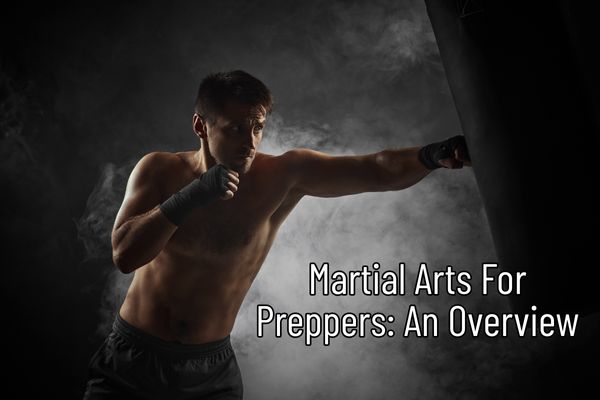
For preppers, knowing how to protect yourself is truly an essential survival skill. It could literally make the difference between life and death one day.
And the first thing that comes to mind when thinking about self-protection is martial arts.
Are you picturing a Chuck Norris or Jean-Claude Van Damme flic right now? Don’t get me wrong, I can’t turn off Bloodsport when I come across it channel surfing. But martial arts are so much more than what you see in the movies.
Along with the ability to fight and defend yourself, learning one or more martial arts builds confidence, discipline, physical fitness, and the ability to function under stress.
However, not all martial arts serve the same purpose. Boxing, Brazilian Jiu-Jitsu, Filipino Martial Arts and Karate each approach combat from very different perspectives and have unique advantages.
A prepper choosing one over another is not necessarily looking to win glory in the Octagon or at the Kumite (see what I did there?), but instead effectiveness in real combat situations.
Which martial art is the best one for you? Let’s walk through the fundamental differences between these four disciplines and lay out why a prepper might select one over another for self-protection.
The Prepper’s Self-Protection Mindset
Before comparing martial arts, it’s important to understand how preppers often think about self-protection. The goal is rarely just winning a fight. Instead, it’s about:
Survival and escape … functioning while stressed … and adaptability during unpredictable situations.
Preppers tend to value systems that work when plans fail, when resources are limited and when situations are chaotic. With that mindset in place, the strengths and weaknesses of each martial art become clearer.
Boxing: Simplicity, Conditioning and Striking Power
What is Boxing
Forget the gloves, mouthpieces and ring girls at the main event in Las Vegas. In true survival situations, we’re talking about old-school bare knuckles here and how preppers embrace the techniques.
Boxing is a striking art focused entirely on punches, footwork, head movement, timing and endurance. There are no kicks, throws, or grappling (though there is clinching). Boxing for the most part is taught as a sport, but through proper training and practice (OK, you’ll need gloves and mouthpieces here), boxing develops exceptional physical and mental attributes and can be used in survival situations.
Strengths for Self-Protection
Boxing’s greatest strength is its simplicity and realism. Punches are among the most natural and common forms of unarmed violence. Boxing teaches how to:
:: Generate power efficiently
:: Maintain balance under pressure
:: Defend against strikes
:: Manage distance and angles
:: Stay calm while being hit
For a prepper, this translates into a skill set that works quickly under stress. Boxing does not rely on complex techniques and the conditioning it builds is exceptional. Cardiovascular endurance, reflexes and resilience are all major benefits.
I’ve spent time boxing and where it shines in my opinion is in its ability to develop physical and mental fighting attributes. Except for Brazilian Ju-Jitsu (BJJ) fighters and Mixed Martial Arts (MMA) fighters, nobody trains harder than boxers. The training gets a fighter into top shape and teaches fighters how to take a hit. My time boxing helped transform me from a martial artist into a fighter. That’s important if you want to survive a street combat situation.
Limitations
Boxing has notable limitations from a self-protection perspective:
:: No grappling or ground fighting
:: No training against kicks
:: No weapon awareness
:: Heavy reliance on rules and controlled environments
In a chaotic real-world scenario, especially involving multiple attackers or uneven terrain, boxing alone may leave gaps.
Why a Prepper Might Choose Boxing
Boxing is appealing for its:
:: Rapid skill acquisition
:: Strong striking ability
:: Conditioning and stress tolerance
:: System that works even when fatigued
Boxing is often an excellent foundation, especially for those who want practical, effective striking skills.
Brazilian Jiu-Jitsu: Control, Leverage and Survival on the Ground
What is Brazilian Jiu-Jitsu
The polar opposite of boxing, Brazilian Jiu-Jitsu (BJJ) focuses on grappling, positional control and submissions. How does one get control of an opponent? How does one apply a joint lock that could break an elbow, knee, or wrist, if the opponent does not surrender? How does one choke an opponent, rending him unconscious? It emphasizes using leverage and technique rather than strength, allowing smaller individuals to control larger opponents.
Strengths for Self-Defense
Brazilian Jiu-Jitsu excels in close-range encounters, especially when fights go to the ground. It teaches:
:: How to escape bad positions
:: How to control an opponent without striking
:: How to remain calm under pressure
:: How to function while pinned or restrained
For preppers, this is valuable because many real-world altercations end up in holds or on the ground, regardless of intent. One thing that surprised me when training with BJJ fighters is how much thinking goes into it. BJJ fighters have to think fast, adapt, and make the techniques work against a non-complying opponent.
Another key advantage is scalability. Brazilian Jiu-Jitsu techniques can be adjusted for injury, fatigue or age. Many practitioners continue training effectively well into later life.
Limitations
Despite its great strengths, Brazilian Jiu-Jitsu has limitations as well:
:: Ground focus can be risky in multiple-attacker scenarios
:: Less emphasis on striking defense
:: Limited weapon awareness in many schools
:: Requires consistent training to maintain timing
While Brazilian Jiu-Jitsu teaches control, it assumes a relatively contained engagement.
Why a Prepper Might Choose Brazilian Jiu-Jitsu
Brazilian Jiu-Jitsu is an optimal choice if you prioritize:
:: Control over brute force
:: Self-defense without excessive harm
:: Survival in worst-case physical situations
:: Skills that age well over time
Brazilian Jiu-Jitsu is particularly attractive to preppers concerned with restraint, legal consequences or defending themselves without escalating violence.
Filipino Martial Arts: Adaptability, Awareness and Weapon Context
What Are Filipino Martial Arts
Filipino Martial Arts, often referred to as Kali, Eskrima or Arnis, is a system that emphasize movement, angles and adaptability. This art teaches how to fight with a stick, knife, or without weapons. Whether fighting with or without a weapon, the concepts are the same, making the art understandable and accessible.
Strengths for Self-Protection
Filipino Martial Arts stands out for their environmental awareness and adaptability. Key characteristics include:
- Training in dynamic footwork and angles
- Emphasis on range management
- Understanding of weapon vs. empty-hand contexts
- Flow between striking, grappling, and disengagement
For preppers, the biggest value is contextual awareness. Filipino Martial Arts encourages practitioners to think about surroundings, obstacles and transitions rather than isolated techniques.
Another advantage is that Filipino Martial Arts often trains both sides of the body equally, improving coordination and resilience under stress.
Limitations
Some limitations include:
:: Quality varies widely between schools
:: Weapon emphasis may not align with every prepper’s goals
:: Less standardized than arts like boxing or Brazilian Jiu-Jitsu
:: Can be overwhelming for beginners
Because Filipino Martial Arts is principle-based rather than rule-based, it can take longer to feel confident in one’s ability.
Why a Prepper Might Choose Filipino Martial Arts
A prepper might gravitate toward Filipino Martial Arts if they value:
:: Adaptability over specialization
:: Awareness of environmental variables
:: Training that acknowledges real-world unpredictability
:: A holistic view of personal defense
Filipino Martial Arts appeals strongly to preppers who think in terms of systems and flexibility rather than fixed responses.
Karate: Structure, Discipline and Stand-Up Defense
What Is Karate
Karate is a broad category with many schools, ranging from traditional to sport-focused. At its core, karate emphasizes striking, posture, distance control and disciplined movement. Karate fighters strike with the hands, elbows, and knees … kick … and block. Skilled karate instructors will also teach joint locking and take-down techniques.
Strengths for Self-Protection
Traditional karate focuses on:
:: Emphasis on balance and posture
:: Development of powerful strikes
:: Structured progression and discipline
:: Mental conditioning and focus
Many karate schools train situational awareness and defensive responses, making them suitable for stand-up self-defense.
Karate also promotes long-term physical health, flexibility and coordination, which are valuable for preppers thinking decades ahead.
Limitations
Karate’s effectiveness varies widely depending on school and instructor. Common limitations include:
:: Inconsistent realism between schools
:: Limited grappling in many styles
:: Over-reliance on pre-arranged drills
:: Less emphasis on pressure testing in some schools
A prepper must be selective when choosing a karate school to ensure practical training.
Why a Prepper Might Choose Karate
Karate is your choice if you value:
:: Structure and discipline
:: Stand-up self-defense skills
:: Long-term physical development
:: A traditional approach to personal growth
Karate often appeals to those who see self-protection as part of a broader lifestyle rather than a narrow survival tool.
Choosing A Martial Art With Intent
Being able to protect yourself and your family is at the top of every prepper’s priority list.
And choosing the right martial art isn’t a decision you should take lightly. You want to understand the approaches and determine your best plan of action.
The differences between boxing, Brazilian Jiu-Jitsu, Filipino Martial Arts and karate are less about which art is better and more about what kind of situations you’re preparing for. Each system presents different strategies, techniques, and training methods for combat .
Boxing is the most stripped-down and immediately functional. It assumes chaos, adrenaline and exhaustion and trains a person to keep moving, keep breathing and keep awareness under pressure.
A prepper drawn to boxing is often someone who values simplicity, conditioning and fast skill development. Boxing works well when plans fall apart and fine motor skills degrade.
Brazilian Jiu-Jitsu represents the opposite end of the spectrum: leverage rather than power. It prepares a person for worst-case physical entanglements like being grabbed, pinned or taken to the ground.
Preppers who choose Brazilian Jiu-Jitsu tend to think in terms of survivability, restraint and longevity, understanding that not every encounter should or can be ended with strikes. However, its ground focus requires careful consideration of context and surroundings.
Filipino Martial Arts is arguably the most aligned with a prepper’s broader worldview. Rather than focusing on one range or method, Filipino Martial Arts teaches adaptability, movement and awareness, encouraging practitioners to think in systems instead of techniques.
Preppers who value flexibility, environmental awareness and problem-solving often gravitate toward Filipino Martial Arts, even if it takes longer to master.
Karate, particularly when taught with a traditional or self-defense focus, offers structure, discipline and long-term development. It appeals to preppers who see self-protection as part of a lifelong practice, not just an emergency skill.
Karate’s effectiveness depends heavily on the school and instructor, but when trained realistically, it provides strong stand-up fundamentals and mental conditioning.
A prepper chooses one martial art over another based on risk tolerance, physical realities, how long it will take to master and philosophical beliefs.
Some prioritize speed and conditioning, others control and restraint, others adaptability and awareness and others discipline and longevity. I’ve been training in multiple martial arts for close to 30 years and my experience is that no one teacher or art will have all the answers. So, cross training in different arts with a variety of teachers can provide a well-rounded education. Just make sure you don’t become a jack of all trades and master of none.
In self-protection, as in preparedness, the best system is the one you will train consistently, understand deeply and apply wisely when it matters most.
FAQs (Frequently Asked Questions)
1. What is the best martial art for self-defense in a real survival situation?
There is no “best martial art.” What’s best depends. It depends on your body type and your personality. It depends on what strategy and techniques work for you. Also, the quality of teacher is more important than the specific martial art. So, when picking a school choose the higher quality teacher rather than the art that they teach.
2. Is boxing enough for self-defense if I don’t learn grappling?
Boxing might be enough. Mastering one art will take any prepper a long way. There are different ranges of fighting that include kicking, punching, trapping, and grappling. Some styles are better than other at certain ranges. So, if you have the time, energy, and inclination, cross training in other martial arts is usually helpful.
3. Why do so many preppers recommend Brazilian Jiu-Jitsu (BJJ)?
Preppers and martial artists recommend BJJ for its training and skills. The training is hard, so it prepares people for the reality of combat. And the skills are applied to fighters who are not complying. BJJ fighters learn how to switch from one technique to another as the opponent fights back. This creates a person who can react effectively in a real combat situation.
4. How useful are Filipino Martial Arts (FMA) for survival and preparedness?
All martial arts are good and that includes FMA. Learn FMA and you’ll learn how to fight without a weapon, but FMA really shines as a stick fighting system. Sticks are easy to find and easy to carry. Using a baton to protect yourself (as opposed to being weaponless), provides an advantage. So, FMA training with a good instructor can be a great fit for preppers.
5. Is karate still practical today for self-defense?
With the right teacher, karate is still effective for self-defense. Karate excels at kicking, punching, and blocking (not to mention elbows and knees). A good karate teacher is knowledgeable in other techniques … like joint locks, chokes, and throws. The question isn’t whether karate is practical, but whether your teacher knows how to fight. Some teachers do and some don’t.
6. Which martial art is easiest for beginners to start with?
All martial arts are accessible and learnable. A better question might be, which martial art is the best fit for you? Try a free introductory class at a few schools that teach different styles. Which style feels more natural to you? And – more importantly – which teacher did you learn better from? All it takes is time and patience and you can master any style.
7. Should preppers train more than one martial art?
A prepper can train in more than one martial art. But I would suggest spending at least two years with one martial art before you start cross training in another. One of the worst things in martial arts is becoming a jack of all trades and a master of none. Get competent in one martial art before starting another.
Disclosure: This content is provided for informational and educational purposes only and does not constitute professional training, legal, or medical advice. Martial arts training carries inherent risks, and results vary depending on the individual, instructor, and training environment. No martial art guarantees success in a self-defense situation. Readers are encouraged to seek qualified instruction, train responsibly, and follow all applicable laws.