I just filled up my Iron Flask at the water dispenser in the fridge without even thinking about it, like I do four or five times a day.
I put it under, hit the button, and the water comes out. I did that same thing last week during a brief power outage and guess what. I was standing there repeatedly hitting the button and no water was coming out.
Luckily, the power was back on in a few hours. But what if it lasted a few weeks or more?
It’s funny, our bodies are more than half water, but somehow we still take access to fresh water for granted.
Power outages, droughts, contamination alerts, these are real concerns that could stop those taps from flowing or make you not be able to drink what comes out of them. Then what?
At some point, you’re probably going to ask yourself the question:
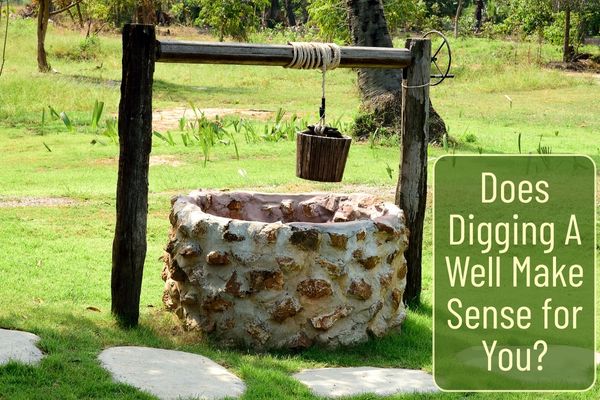
“Should I just dig a well and be done with it?”
Your own water. You don’t have to rely on anyone else. More independence. Seems like a great idea. But there is certainly a lot to think about.
Like most pumps actually work on electricity, but we’ll get to that.
When a Well Makes Sense
There’s a huge difference between urban and rural prepping, in general.
If you’re on rural land, your property probably already has a well. And if it doesn’t, drilling one is pretty much the norm.
In suburbs though, it’s a different story completely. You’re tied into municipal water. There are rules. Sometimes strict ones. Lot size, distance requirements, permits; it can get complicated fast. In some places, it’s not even allowed.
Also, if your plan is to leave during a serious crisis, dropping thousands into a well probably doesn’t fit into your plans.
But if you’re building a long-term setup for emergencies, it’s most likely the right call.
The Cost People Don’t Want to Talk About
Let’s get it out there, putting in a well is definitely not cheap. Depending on where you live, drilling can run anywhere from a few thousand to tens of thousands of dollars. And that’s if everything goes right.
If you’re dealing with rocky ground, deeper water tables, or you run into access issues, the cost goes up.
And you’re not done going out of pocket once the well is drilled. There are pumps, pressure tanks and electrical systems to think about. Don’t forget about the maintenance and repair costs.
Oh yes, and then there’s testing. Just because it’s groundwater doesn’t mean it’s clean. You may need to filter or treat that water depending on what shows up and do it on a constant basis.
What Happens When the Power Goes Out?
It’s true. You can have a perfectly drilled, fully functional well and still be stuck without water if the grid goes down.
Most wells rely on electric pumps to pull the water up. But no power doesn’t necessarily mean no water; it just means you have to find a backup plan for getting that water.
My friend, Aaron, has a well at his upstate farmhouse in Vernon, NY. It’s a beautiful place on fifteen acres. He was old school with a manual hand pump ready to go when the power went out. That was until he hit fifty or so. Now he has a generator setup. Smart move.
You can also have a solar-powered backup system, but that could go wrong in a hurry as well if the sun is hidden away for long stretches. Some people swear by it, not me though.
Lawyer Hat Stuff
Even if it’s your land, you don’t always have the right to just start drilling. And it could be a pretty lengthy process. We’re talking permits, having licensed professionals doing the work and then inspectors coming in at different phases and giving their OK.
Plus, before you even start drilling, you have to think about where your well is going and what’s around it. It has to be far enough away from septic systems, property lines and things like that. Get it wrong and you could be facing big fines. You may even have to fill it in and start over from scratch.
And here’s the kicker. Even if your state allows you to put in a well, your town might not. Oh, the bureaucracy. Make sure you check that out.
Potential Pitfalls
“There has to be water down there, right?” Nope, not always. Some land has very deep or inconsistent groundwater. And on top of being frustrating, that can get real expensive, real fast.
And you’d think that if the property next door has a good well, you should be fine with yours. Unfortunately, it doesn’t always work out like that.
Then there are those who think that it’s groundwater, so it has to be clean. Nope, again. Could be natural or done by human hands, but that water could be contaminated. Get it tested and then if you need to, get it treated.
Alternatives To Consider
So, at this point, if you’re already thinking, “Wow, that’s a lot,” I get it.
There are some much simpler solutions to address your water worries.
People have been collecting rainwater for thousands of years. It’s easy, does the job and you could ramp it up to whatever size you’re comfortable with.
A basic setup with gutters, downspouts, and a storage container can start collecting water the first time it rains. From there, it’s just a matter of how far you want to take it. The dry seasons could be a problem though.
Then there’s my favorite. Water storage. My house is filled with those “just in case” containers. Even if you live in a tiny apartment, you can find room.
If you’re lucky enough to have access to a stream, lake, or pond, you have a perfect solution right there. You will need a filtration system, for sure. I wouldn’t recommend drinking up that pond water as-is, tadpoles and all.
Final Thoughts
You see that picture already in your mind. A newly drilled well, right in your own backyard, that you alone control. Your own, personal water supply. It’s like gold.
It does mean more independence for sure, but it’s not a quick fix. It’s a big commitment. Financially, logistically, and long-term. There are a lot of steps involved and things that might not go as smoothly as you would hope.
So, you have to ask yourself, does it really make sense for you?
Odds are you’re not going to be drilling in the big city, but if wells are common where you are, you can check that box.
If you have a “bug-out” mindset, you probably want to pass and stick with a water storage system, like me.
Do the legwork and find out if water is accessible. Think about what your backup plan is going to be for getting that water up if the power goes out. Make sure you see the full picture.
Put it all down on paper from step 1 to completion, taking into account everything that could happen. Then if it still makes sense, get started.
BIO: Anthony Vion is a lifelong prepper from Long Island, NY, with decades of hands-on experience in resource planning. He focuses on practical, approachable strategies for managing water and food supplies, power, and other essentials, as well as helping households stay safe and resilient during everyday disruptions.
This article is for informational purposes only and isn’t a substitute for professional advice. Well systems, water access, and regulations vary by location. Consult qualified professionals and verify local requirements before making decisions. You are responsible for how you apply this information.