You’re halfway through clearing a patch of overgrown brush on your property when it happens. One step forward, a quick shift of weight, and a sharp sting you never saw coming.
Or maybe you’re hiking deeper into a trail than planned. You decide to step over a fallen log instead of stepping on it. Then, bam. Out of nowhere, you’re bitten.
This isn’t what you see on TV or in the movies where a hero stares quietly at the snake telling everyone not to move. This is real life, and it did just happen.
Thankfully, it’s not all doom and gloom. You can walk away from most snake bites, especially when you address them right away.
In this article, I’ll walk you through what to do when help is far away, how to recognize a dangerous bite, what to do when you’re on your own, and if possible, how to avoid getting bitten in the first place.
How To Help Avoid A Snake Bite
Believe it or not, most snake bites are preventable. The problem is, we’re not thinking about getting bitten as we go about our lives. But here are a few tips that can help keep you safe.
Step on logs or rocks instead of over them. This way, you’re not surprising anything you can’t see on the other side. Try to avoid reaching blindly into anything, but especially holes, brush, and woodpiles.
Wear boots and long pants when hiking in areas where snakes may be hanging around. Also, be sure to have a flashlight when walking at night. You always want to keep your campsite clean anyway, but if you need extra incentive, you’ll keep rodents away, which get a snake’s attention fast.
Oh, and forget everything you’ve seen in the movies. If you try to handle, move, or kill a snake, it’s probably going to end badly for you.
What To Do Immediately After Getting Bitten
Once you realize what just happened, get as far away from the snake as possible. You don’t want a second bite, that’s for sure.
You want to try to stay calm. Easy to say, right. But the more you move, the faster venom spreads. Panic is never helpful and especially not in this situation. Concentrate on the bite itself and keep the area at or slightly below heart level.
Get whatever tight items you may have away from the area. Rings and watches, even a tight shirt or pair of pants, can get dangerous as the swelling gets worse. If you have water, rinse the wound gently. Don’t scrub it too hard. Also, this isn’t the time to be digging through your first aid kit for the first time trying to figure things out.
Keep the limb as still as you can. You can use a splint if you know how. From there, it’s time to find medical help ASAP. Move slowly and deliberately if you have to, but you may be better off calling or radioing for help.
And you can forget about those commercial snake bite kits. Most of them are outdated and their effectiveness is questionable.
There are also some critical things NOT to do, like cutting the wound or trying to suck out the venom (another terrible movie thing). No tourniquets. Don’t apply ice. And you’re not going to like hearing this one: don’t drink any alcohol or caffeine. Sorry.
The Dangers Of Venom
Snake venom affects the body in different ways.
Hemotoxic venom (common in pit vipers) damages tissue and blood cells. Along with the pain, you may see a good deal of swelling, bruising, and sometimes serious tissue damage.
And as if that wasn’t bad enough, there’s neurotoxic venom (like coral snakes) that goes after the nervous system. This is where the situation can turn serious fast, potentially leading to breathing issues and even paralysis.
In both cases, you want to stay as calm as possible. Time and how your body responds are important. The faster your heart rate and movement, the faster that venom can circulate.
Not every snake is venomous, but this is one of the cases you should assume the worst.
There are some tell-tale signs you want to look for like fang marks, but these may be subtle and hard to see. What won’t be so subtle though is the immediate pain or burning sensation.
Swelling that spreads from the bite and discoloring of the skin or bruising are fast followers. Then you may get nauseous, start sweating bullets and feel an overall weakness sink in. In severe cases, you may have a hard time breathing and get very confused.
Even if symptoms only feel mild at first, they can kick into overdrive in a hurry.
Venomous Snakes Around Us
These are the culprits to watch out for in North America and where you’re most likely to come across them.
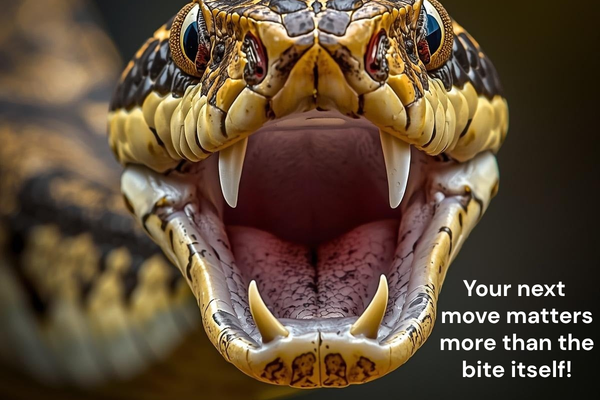
The most common threat is your Pit Vipers. You’ll find Rattlesnakes in the Southwest, slithering around deserts, grasslands, and rocky areas. Most of the time they’ll give you a warning with that rattling tail of theirs, but I wouldn’t count on it.
Copperheads are in the Eastern U.S., mainly in forests or on the edges of suburbia. These guys blend right into the background with their camouflage, so they’re easy to miss.
Cottonmouths (you may know them as Water Moccasins) are in the Southeast, usually near swamps, lakes, and slow-moving streams. If you come across one, they’ll most likely be on the defensive, but I’d still watch out.
Coral Snakes are definitely less common but just as dangerous if not more so. Primarily in the Southeastern U.S., they’re hard to miss with their red, yellow, and black banding. Bites are rare, but you’ll want to get immediate medical attention.
When Survival Gets Critical
Severe envenomation is a real technical-sounding term, but it’s also a critically dangerous situation.
That’s when swelling shoots up a limb lightning fast, you’re having a hard time breathing, you feel confused or so weak that you collapse or even lose consciousness.
At this point, it’s life-threatening without antivenom. Immediate evacuation or signaling for rescue should be your main focus.
Final Thoughts
Most snake bites can be avoided if you stay aware of your surroundings and situation. But, with that said, things happen.
If you do get bit, just remember to stay calm. You don’t realize how fast panic takes over until something like this happens. If you start running at top speed and flailing your arms around, that venom is going to spread a whole lot faster.
Forget about sucking out the venom. Keep that limb still, don’t poke at or cut the area, and no tourniquets. Then get medical attention as soon as possible.
Personally, I prefer the option where I don’t get bitten in the first place.
FAQs
1. How long do I have to get help after a snake bite?
Could be hours or minutes. Keep calm and get medical attention ASAP.
2. Can you survive a snake bite without antivenom?
Most cases, yes. But severe envenomation can quickly become life-threatening.
3. Should I try to identify the snake?
I wouldn’t. Getting a 2nd bite because you didn’t get away fast enough will only make things worse.
4. Are baby snakes more dangerous than adults?
No. But you don’t want to get bitten by either.
5. Can I walk after being bitten?
Avoid it if you can. Any movement will make the venom spread faster.
6. What’s the best way to avoid snake bites altogether?
Stay aware, good boots, oh yeah, and never stick your hands into any place you can’t see into.
BIO: Anthony Vion is a lifelong prepper from Long Island, NY, with decades of hands-on experience in outdoor safety, self-reliance, and practical skill-building. He focuses on breaking down complex ideas into clear, usable advice that readers can actually apply.
This article is for informational purposes only and does not constitute medical advice. In the event of a snake bite, seek professional medical assistance as soon as possible. Preparation and knowledge can improve outcomes, but they are not a substitute for proper care.