The first thing that pops into my mind when thinking about the survival knife is John Rambo in the 1982 film First Blood. If for some reason you haven’t seen it, I highly recommend you do so right after you read this.
He pretty much does everything you can do with a survival knife here, and some things you shouldn’t. While he makes throwing it look pretty cool, you’re most likely going to damage yours that way.
Yes, a survival knife can be used to protect yourself and your family. But this all-purpose tool is so versatile, it’s hard to imagine how a prepper can live without it.
It can help you curate materials (like tinder) for a fire … split kindling … be used to create a spark to the the first going … notch wood for shelter joints … scrape bark for roofing … clean fish … butcher meat … carve tools … make a splint … mark a tree for navigation … open a can or container … and that’s just for starters.
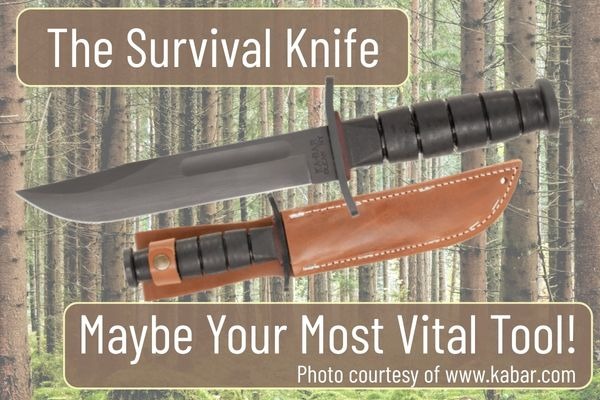
Even the U.S. Marines use knives like the KA-BAR because it is simple, durable and deadly.
The Classic Survival Knife
I’ve seen knife design change thanks to outdoor enthusiasts (making bushcraft knives popular). But for preppers, a durable survival knife that’s a jack of all trades, can be super handy – if not indispensable.
Unlike folding knives with their moving parts, the survival knife has a fixed blade and ideally has a full tang (absolutely essential when you’re breaking through something strong like wood). A good length is usually between 4 to 7 inches. That’s long enough to handle tough work like cutting branches, but short enough for ease of carrying and tight quarters.
For blade material, you have two choices. Carbon steel is tough and easy to sharpen. But it takes a little more care to keep it from rusting. For me that’s not a bad trade off at all. Then there’s stainless steel. It won’t rust as easily … a plus. But stainless steel can be more of a hassle to sharpen. I like carbon steel, but that’s just me.
Personal advice: Make sure you get a knife with a full tang (or a blade that extends all the way through the handle). I’m not saying blades without full tangs are bad … but why go without the strength a full tang provides? And I like a lowered drop point shape for more piercing strength and more effective cutting.
For the handle, you’ll mostly find them made of micarta, G-10, or rubber composites, you know for a solid grip without the extra weight. Preppers like you and me could be out in wet and muddy places … so, we need to know the handle will feel secure and comfortable no matter what the conditions.
If you like extras built into your survival knife (like serrated edges and built-in fire starters), that’s okay. But never, ever sacrifice blade strength and design for gimmicks.
And what about your sheath? That’s important too. It should be your knife safe, secure, and dry. Kydex or reinforced nylon are the standard and you don’t need to go any further than that.
Oh, What You Can Do With It
Calling a survival knife a multi-purpose tool is doing it a colossal injustice.
Let’s start with the most obvious. For self-defense, you’re not going to find a better, more intimidating knife for its size. And don’t say machete because you don’t want to be lugging one of those around everywhere you go.
For food, unless you’re a green beret or ninja of some sort, you’re probably not going to take down a deer or rabbit with a survival knife. It does an awesome job skinning and preparing them though. It’s also great for cleaning fish (watch those scales fly), slicing meat and even opening cans.
My advice: Buy quality. This is going to be one of your go-to tools. When I’m training my bushcraft, a survival knife has helped to provide shelter … clean fish … butcher game … and build a fire. A good survival knife – in my opinion – is NOT the thing to go cheap on.
The Best Of The Best
Want some help picking a quality survival knife? Yeah, These are the names you want to know when you’re eyeing an exceptional survival knife.
KA-BAR – This one is my recommendation. KA-BAR was tried and tested in World War II. It’s been standard issue for the U.S. Marines as a fighting knife. It’s tough as all get out and has an effective blade geometry.
• ESEE Knives – These knives bring together edge retention and ease of field sharpening. They’re tough … reliable … and feature a non-nonsense design. And their “no questions asked,” lifetime warranty is legit! This is a brand you can trust.
Morakniv – It’s hard to go wrong with these survival knives that combine exceptional affordability and Swedish steel quality. You’re sure to get reliable edge retention … ergonomic, rubberized grips … and a versatile Scandi grind. Perfect for carving, camp tasks, and everyday carry in the woods.
• Benchmade – These babies come with a higher price tag, but it’s worth it. These knives feature premium steel, superior edge retention, and rugged construction.
• Fällkniven – Fällkniven leans into performance and durability. These blades feature high-quality VG10 or CoS stainless steel in a convex grind. Tough. Sharp. Reliable.
I’m a big fan of KA-BAR. But go with the knife that’s right for you. Just keep in mind a size and weight you’re comfortable with. Also, what steel blade is right for you and a grip that’s secure in all conditions.
Tips And Maintenance
Sharpen, sharpen, sharpen. There’s nothing worse than a dull blade when you’re trying to get something done. It’s like trying to saw through a piece of wood with a spoon. I sharpen my survival knife every week or so, but I’m a bit neurotic. Depending on how much use you get out of yours, you can figure out your sharpening schedule.
I clean and dry my blade every time I use it and put on a light coat of oil to keep the rust away. You just need to do that for the carbon steel blades.
Final Survival Knife Thoughts
I hate to say it, but I’d be lost without my survival knife. Well, maybe not lost, but I’d grumble a lot wishing I had it back. I guess once you have something that’s so valuable, it’s kind of hard to live without it.
I’m no Rambo, but when I’m in the woods, my KA-BAR is like an extension of my hand. Making a shelter, preparing dinner, cutting kindling for the fire, it’s always with me making my life easier. And I’d be lying if I said it didn’t make me feel safer sheathed at my side.
There are a lot of solid brands out there, so check them all out. When you’re ready to buy though, I strongly recommend doing it in person, not online. You want to see how it feels in your hands.
Then when you bring it home, get familiar with it. Feel how it cuts, how it handles and how it performs under pressure. Keep it sharp and take good care of it and it will help take care of you for years to come.
OK, now go check out First Blood if you haven’t seen it yet. It’s a classic and probably the best survival knife movie of all time.
Anthony Vion is a lifelong prepper from Long Island, NY, with decades of hands-on experience in outdoor living, tools and equipment, self-reliance, and practical skill-building. He focuses on breaking down complex ideas into clear, usable advice that readers can actually apply.
This article is provided for general informational purposes only. It’s not a substitute for proper research, professional training, expert instruction, or official safety guidance. The information shared here is based on personal experience and general knowledge and may not apply to every situation or skill level.