We moved into our new house in 2006. I think it was about two years after that I was standing in my garage, staring at shelves full of supplies, and feeling pretty good about myself.
I remember smiling and almost breaking my arm patting myself on the back. That was pretty much the exact moment the lights went out.
No problem, I confidently thought. I walked over to my workbench where I have everything meticulously in place. I found my trusty flashlight in the dark, flipped the switch and… I was still in the dark.
Then I thought, when was the last time I used this flashlight? I don’t think it was even in this house.
So, I trudged through the dark garage and into the house to get the flashlight in my den. I didn’t need any light to find that one either. Picked it up, flipped the switch and let there be light.
For about thirty seconds. Then the beam dimmed, and again I was standing in the dark.
Now some choice words started flowing and of course this was when my wife got home with our daughter, who was eight at the time.
“Why don’t you get the flashlight,” she said. I groaned and told her what happened, then trudged back into the garage to look for new batteries.
Well, the bins weren’t as organized as I had thought. There were only AA and AAA batteries in the first one. Digging through the second bin, I came up with three C batteries, and of course I needed four.
I was still searching when the lights came on five minutes later.
I felt rather unprepared at that moment and wanted to kick myself for the over-confidence I was feeling earlier.
You can have all the gear in the world, but if it doesn’t work or you can’t immediately find what you need, you’re not prepared.
But honestly, similar to my first vegetable garden failure, I’m grateful for every one of those mistakes I’ve made because they made me a better prepper.
Organization Is Just as Important as Supplies
If you’re anything like me, you have a bunch of bins in your garage and basement. I thought I was smart because I swapped out all of my traditional bins with see-through bins.
I would have been smarter to keep the old bins, save the money, and label the contents.
I think it was a week or two after the batteries fiasco in the garage, there was a big storm coming and I wanted my hand-crank radio. I remember asking my wife if she had seen it. She reminded me that I had packed it away in a bin in the basement.
Well, it took me about forty-five minutes to find it and when I did, I was so disgusted I didn’t even bring it upstairs.
Try to keep similar items together. I can’t tell you how many times we would finally find candles only to have to go on another scavenger hunt for something to light them with. Ever since I started making candles, I always store a few boxes of matches with them.
One of the best things you can do to stay organized is to make an inventory list. I do the same with what’s in the freezer and pantry, so why not with everything else.
This one sounds like common sense, but store your emergency supplies where everyone can get to them. And check those flashlight batteries a few times a year.
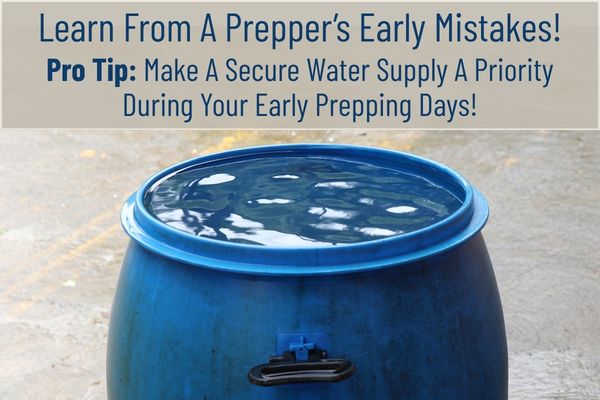
Water Should Have Been My First Priority
When I was first starting out, I bought canned goods, freeze-dried food, and enough pasta to open a small Italian restaurant.
And do you know how many gallons of water I had stored? Two. Just two gallons.
Not too bright, considering you can survive much longer without food than without water.
Now, I keep more than an adequate supply of emergency water stored with all the containers dated and rotated. Plus, I have several ways to make questionable water safer.
Being Prepared Doesn’t Come From a Store
Years ago, I remember coming out of Costco with a wagon filled with supplies and a $600 bill. Now I look back and wonder what the heck I was doing.
I got home and my wife just gave me that look as she stared at two cases of Dinty Moore beef stew and a pile of other stuff we didn’t need.
I was also stocking up on fancy gear I didn’t need, like that compact fire starter kit I ordered from Amazon and never even used. I think I gave that away to my cousin, Danny, without ever taking it out of the box.
It would have been smarter if I did things like knowing where all the shut-off valves are.
Be Ready For The Little Things
I spent way too much time thinking about what would happen if a category 5 hurricane hit instead of stuff like the car battery dying or a basement pipe leaking.
Being a homeowner for over twenty years, it seems like little emergencies happen on a weekly basis. The kitchen sink is leaking. The refrigerator isn’t staying cold enough. The air conditioner is making a terrible noise. A snowstorm that keeps us home for two days.
Don’t totally put big disasters out of your mind, but don’t forget to focus on things like being prepared for a three-day power outage.
You Don’t Need to Do Everything at Once
That $600 Costco run still has me shaking my head. I tried to store a year’s worth of food in a day. And even worse, it was cases of the same food that I would have to be eating over and over again.
Listen, I like beef stew, but I think I would start hating it if I ate it every day for a month.
Over the years, I got a lot smarter. Now, when I go on my weekly shopping trip, I add an extra bag of rice here, and an extra can of beans there. And the food supply in my pantry gives me a lot more options.
Also, I was trying too hard to learn new skills. Now, I take them one at a time. Candle-making is a good example. I spent about a week focusing mainly on that. Now, I’m not an expert by any stretch, but the candles I make work and don’t look too bad.
Final Thoughts
It’s obvious I had two major problems.
I thought I knew everything, but I really didn’t know a whole lot about what being prepared really means. And I thought I needed every new fancy gadget out there, when what I was using for the job was fine or in some cases, even better.
That day in the garage fumbling through bins for batteries was probably the last time I broke my arm patting myself on the back.
If there’s one thing I’d tell younger me, it’s this: you don’t really find out how prepared you are when you’re buying things. You find out when you need them.
But every mistake taught me something useful.
Hopefully, a few of these lessons can save you from making some of the same mistakes.
About the Author: Anthony Vion is a lifelong prepper from Long Island, NY, with decades of hands-on experience in self-reliance and practical skill-building. He writes about everyday prepping in a straightforward, realistic way, with a focus on simple steps that help families stay ready for the unexpected.
The information in this article is based on personal experience and is intended for general educational purposes only. Every situation is different, so use your own judgment and seek professional advice when needed, especially for medical, safety, or emergency-related matters.