Even the most seasoned preppers can make mistakes, but most mistakes can be avoided with proper planning and prepping.
Here are 10 additional mistakes that preppers should try to avoid.
<1> Not Considering Long-Term Prepping
Preppers oftentimes make the mistake of prepping to meet the demands of a duration of only a few weeks or less. But how will you and your family survive over an extended period, whether for a few months or even years? Preppers need a long-term plan regarding food, water, shelter, communication, first aid, and other necessities.
One example of long-term prepping would be to invest in a more durable shelter than a temporary tent structure to safely and comfortably house your family for an extended period. Learn how to preserve food, filter all available water supplies, raise animals like chickens, fish, hunt, and acquire food through gardening and other sustainable resources.
One priority should be acquiring long-term supplies for life and death essentials … fire building. Take a moment now to look at your prepper stockpile. Make the necessary changes now to be ready for prolonged periods of critical survival efforts that can sustain you and your family.
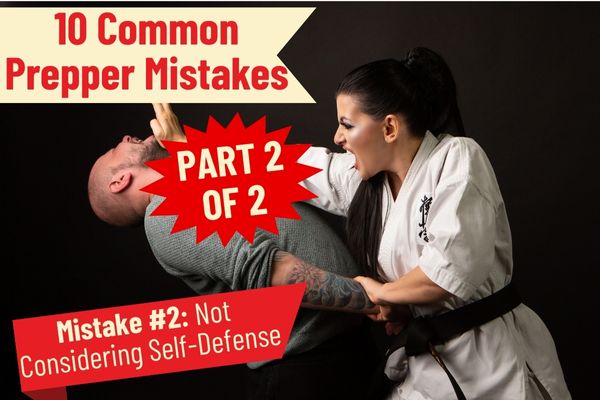
<2> Purposely Not Considering Self-Defense And Personal Safety
It can be hard and even uncomfortable to consider the topic of preparing to protect you, your family, and your supplies. Remember this, you can’t always rely on law enforcement or governmental intervention during periods of widespread emergency. When push comes to shove, preppers must do what it takes to protect their family and themselves.
Disasters can instigate desperate actions when supplies are scarce. Others may want to steal your food, water, cash, tools, and other prepping supplies vital for survival. Should a looting scenario develop in front of your eyes, you will need to defend yourself, your loved ones, and your possessions.
In a survival situation, personal safety is of the utmost importance, so you need to prep for self-defense. Take self-defense classes and invest in the weaponry that you’d be comfortable using (such as guns, pepper spray, a survival knife, or a billy-club). Be sure to gain the proper certification and understand the weaponry laws in your county and community.
<3> Lack of Training For Many Scenarios
And speaking of training like defense, while it’s impossible to anticipate and plan for every scenario, you must consider training for as many unexpected scenarios as possible. Preppers need to both gain knowledge and be able to apply that skill under pressure.
For example, bugging out may require a two-mile walk with a heavy backpack in a cold, wet environment. Could you find a safe location and immediately gather supplies in nature to build a fire? You may think you have the know-how and physical prowess to succeed, but without practical experience, you can’t have 100% confidence in your skills.
Knowing survival skills and performing survival skills are very different. The time to see whether you can survive a real-life natural disaster is to get hands-on practice now.
<4> Failure to Download Critical Apps on Your Mobile Device
Don’t make the mistake of getting caught in a life-threatening disaster without the critical answers, updates, or knowledge you need. Whatever the scenario, your cell phone can be a vital tool for survival and each app that you download now can be a lifesaver later.
Apps on your cell phone can offer you navigation, weather, news, flashlight, camera, how-to videos, first aid, and many more essential tools for survival. Consider apps that provide real-time notifications and breaking news alerts, communication assistance in dire circumstances, and other aspects of preparedness. Be sure to familiarize yourself with each app and customize the most vital features of the app.
Being prepared now means that your cell phone has helpful apps to give you the assistance that you need. And remember, even without internet service, most downloaded information on an app should still be available for your reference.
<5> Failure To Plan Alternate Communication Methods
And speaking of cell phones, a huge mistake would be to not consider alternate communication methods. Never rely solely on your cell phone during an emergency. What will you do if your cell phone loses power? Or, what if cell service is interrupted? Communication is critical while a natural disaster is occurring.
Consider investing in alternate communication methods like a HAM radio, that operates without using the internet. Even more impressive is the fact that with a ham radio, you can communicate locally or across the globe. HAM users transmit directly over the airwaves using their own radios and antennas. It’s a licensed activity that preppers can rely on to broadcast and receive critical communication during disaster scenarios.
<6> Not Considering Seasonal Prepper Gear
Another prepper mistake is to not evaluate or update prepper essentials when a new season begins. Every new season brings on a whole new set of disaster scenario concerns. Prepper supplies vary greatly, especially when facing the brutal heat and humidity of summer to the always changing hot/cold fall season, and then onto the chill of winter. Preppers need to contemplate prepping needs for all seasonal challenges and especially the unpredictability and intensity of Mother Nature.
Prepping to stay warm or cool, fed, and hydrated can be accomplished by labeling your prepper supply for changing seasons. Prep with warm clothing, hand warmers, extra firewood, and insulated shelter supplies for cold months. Include boots and rain gear for the rainy season and potential flooding issues. Insect spray, allergy medications, and sunblock are a necessity in spring and summer months. A little extra prepping effort now will avoid the ramifications of not being seasonally prepared.
<7> Not Considering Waste/Sewage Management
Not prepping toilet solutions for a disaster scenario could be a big mistake. Please understand that waste/sewage management is an important issue and can potentially cause more serious repercussions. You see, prepping for waste management is more than just creating a toilet. Disposing of human feces incorrectly can cause illness and spread deadly diseases. It’s important to prepare now for the necessary supplies and equipment and skills needed to manage human waste during an emergency.
You’ll need sewage management whether you’re out in the wild or at home coping with a downed local sewage system. Compost toilets, cat holes, trench latrines, bucket toilets, and commodes are just some options. And as difficult as it is to consider, it’s necessary to manage the knowledge, skills, and supplies.
<8> Not Adding Tactical Clothing to Prepper Supplies
If your survival is in jeopardy, you’ll need to dress for success. And that means tactical clothing. Tactical clothing is made to meet the demands and purposes of the military, law enforcement, outdoor enthusiasts, survivalists, and preppers. Each clothing design is created to ensure durability to perform in challenging situations and disaster scenarios.
Tactical clothing is made of sturdy materials that cover up various body parts to help avoid scrapes, cuts, and sunburn in outdoor environments. Colors of tactical clothing typically feature camouflage colors like brown, dark green, black, gray, tan, and navy blue. Be sure to stock up on tactical boots, pants, jackets, socks, shirts, and hats. In emergency situations, you’ll appreciate the specially-designed pockets and loops to hold essential prepper tools.
<9> Overlooking the Importance of Training Others
It’s a mistake to consider yourself the only prepper in the house. Your family members can also gain knowledge, training, and survival skills. You don’t want everyone to rely solely on your prepper expertise during a disaster scenario. That is an unnecessary burden to carry. And while prepping may be an uncomfortable topic for all family members to face, you can subtly introduce your prepper plan and assign roles for each family member.
You may be surprised at the valuable contribution each family member provides. Younger folks have a good knowledge of current apps and are most likely in tip-top shape to help build shelter. It could also be fun to seek training together for self-defense and first aid. Activities like hiking, camping, fishing, outdoor cooking outdoors, gardening are great ways for everyone to gain skills and experience.
<10> Neglecting Your Pet’s Needs During Prepping
Pets will need to be considered when prepping for food, water, shelter, and first aid. Prepping for pets does not need to be extensive. Simply keep extra pet food, pet treats, pet carriers, leashes, and collars on hand and ready to grab. Continually use and replace the backup pet food as it can spoil over time. When you’re calculating water supply for your family, also add water for the pets. If your pet relies on medication, have back-up meds along with flea and tick prevention for long-term situations.
Also consider scenarios that involve evacuating to a local shelter. Not all shelters accept pets, and you don’t want to leave your pets alone at home during an emergency. Do your homework and find pet-friendly shelters. Note that many shelters require proof of vaccinations, so store pet records in your bugout bag. You may even consider creating a pet bugout bag to hold all pet essentials.
Fix Your Prepper Mistakes Now to Avoid Issues Later
Once a disaster happens, it may be too late to fix a prepping mistake. Contemplate this list mistakes and do what you can to strengthen your weak areas, add the right supplies, and take the necessary steps to be ready for any scenario.