Last November, my wife and I were heading out east to Montauk for our anniversary. It had been raining off and on for a week straight, but that day the sun was shining bright on us.
We got into town around noon and couldn’t check into the hotel until 1 pm, so we just drove around and ended up at one of our favorite spots overlooking the water.
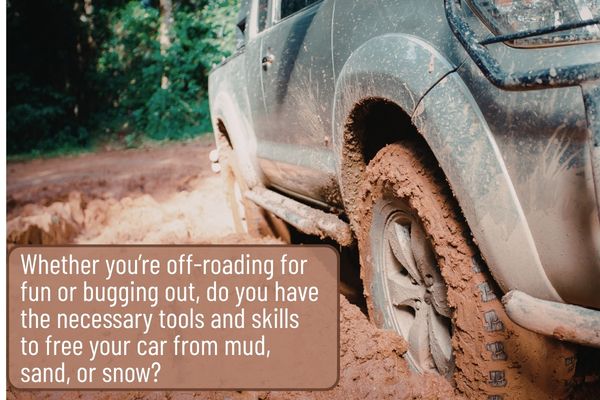
As soon as I pulled off the road and onto the grass, I knew it was a mistake. My wife felt it, too. The front tires sank into the ground.
I tried backing up but we weren’t going anyway. So, I got out to try to push and had Deb move over into the driver’s seat. I pushed, she gave it a little gas, and no luck.
I popped the trunk to see if I had anything useful in there but just jumper cables, a jack and the spare tire.
I was getting ready to call my buddy Shane to see if he could come tow us out. He worked nights and wouldn’t have been too happy that I woke him up to drive an hour and twenty minutes to help us and then drive another hour and twenty minutes back. But he would have done it.
It was right then that a Ford F-150 passed by, stopped and reversed back to us. The driver smiled and asked if we needed some help. Then I smiled and said, “We sure do.”
Well, he broke out his recovery strap, got to work and had us out of the mud and onto the gravel in minutes. I offered him twenty dollars, but he waved it away and said, “Just pay it forward.”
At that moment, as I was standing there waving goodbye in my muddy shoes, I started thinking how differently that could have gone if we weren’t right out on the main road.
What if we were miles into the woods, off-roading or at a campground? And it’s not just mud. We had a lot of snow this winter and could have easily been one of those cars we would see stuck on the side of the road. Sand could cause big problems, too.
When we got home from our weekend away, I started doing some research on putting together a vehicle recovery kit.
It Starts With The Right Recovery Strap
I was in Key West on spring break in 1992 when my buddy Don thought it would be a good idea to drive his car onto the beach. It was a Pinto and it wasn’t a good idea.
A half hour or so later, some guy drove up the beach in a beat-up truck and said he would pull the car out for ten bucks. He hopped out, reached into the bed of the truck, and pulled out an old rusty chain. Then he wrapped it around Don’s back bumper.
This guy hit the gas and that back bumper shot right off the car. We all started to laugh hysterically, except for Don. I think I remember him saying overall it cost him almost six hundred dollars to fix, and that was way back then.
Looking back, though, it wasn’t really funny. Someone could have gotten seriously hurt.
I guess that was the long way of saying that I made it my number one priority to make a solid recovery strap the centerpiece of my vehicle recovery kit.
There are a few different kinds, but I wanted one with little to no give, specifically made for another vehicle to pull mine to get it unstuck. And doing it without causing damage to either.
You don’t want to confuse that with a tow strap that’s really made for towing rolling vehicles.
If you want to take it a step further, there are also kinetic recovery ropes. These stretch under tension and use the stored energy to gently free a stuck vehicle. Off-roaders and overlanders, like my cousin Danny, swear by them.
Danny got his son’s quad stuck so deep in the mud, he probably never would have gotten it out of there without a kinetic strap. After hearing that, I decided I should probably have both.
Whatever you choose, just make sure it’s rated well above the weight of your vehicle.
Recovery Shackles
OK, now you need a way to securely connect that recovery strap to the vehicles.
Basically, there are two options. Steel D-ring shackles have been around forever and they’re incredibly strong. The one downside is, if one breaks when you’re using it, watch out. It could turn into a small missile.
I went with soft synthetic shackles. They’re lighter and easier to work with. Danny said it was a good call, as well.
A Small Shovel Solves Big Problems
My first instinct is always to hit the gas when I get stuck, even though it rarely works and usually just makes things worse.
But now that I have my folding military-style shovel in my vehicle recovery kit, I’m a little smarter about it.
Getting out of the car and just removing a little bit of mud, snow or sand out from behind or in front of the tire does the trick most of the time.
Traction Boards
When I first saw traction boards, I was on the fence about adding them to my kit. Then I watched VanDoit Vans’ Best Traction Board Self Recovery Procedures video on YouTube and was sold.
It’s so simple. Just slide the boards under your tires to give them something solid to grab instead of spinning aimlessly in snow, mud, sand, or loose gravel.
And the best part, you don’t have to hope for another vehicle to show up to pull you out.
Granted, they aren’t cheap, and they take up some space, but they are well worth it in my opinion if you spend a lot of time off-road or overland driving.
Portable Air Compressor
I learned this one from my cousin Danny as well. If you’re driving on the beach or somewhere else through deep sand, lower the tire pressure. His words, “It gives the tires a bigger footprint.”
But once you’re back on pavement, you don’t want to be driving with your tires that low.
You can get a decent portable compressor for under $100, but I went with the ETENWOLF VORTEX S6. You can get it for about $120 on Amazon. It was also just rated the #1 Portable Tire Inflator by CTR.
I use it a lot more than I thought I would, like on those cold days my wife’s tire pressure light comes on. And better than having to head to the gas station to pay for air.
I also have two tire pressure gauges, one battery-powered and one manual.
Heavy Work Gloves
We’ve all been there. Working out in the cold or with sharp material with no gloves. Well, I don’t want to be there again.
Mine are leather, but you can find decent synthetic pairs. I also keep them in a waterproof bag, just in case.
Recovery Blanket
I’ll be honest, this one wasn’t even on my radar when I first started putting my recovery kit together.
Then I saw what can happen if a recovery strap snaps.
A recovery blanket is simply draped over the recovery strap while it’s being used. If something goes way wrong, it helps reduce the violent snap-back.
Hopefully, I’ll never need it. But for the small amount it costs, it’s more than worth it.
Tire Repair Kit
I used to head up to the gas station on the corner whenever I found a nail or screw in my tire. For twenty bucks, they’ll pull the nail and patch the tire.
Then, I wondered why I was paying them to do it? It’s easy enough.
Flashlights and Headlamps
I prefer my headlamp since it keeps my hands free, but I have a flashlight in my kit, too. And some extra batteries.
And it doesn’t have to be for a situation that happens at night. It could be the brightest day and sometimes I still need a light to see into places.
Recovery Gear Storage Bag
I just use a heavy-duty storage bag to pack everything together. What good is your gear if it’s scattered everywhere and you can’t find what you need, right?
It also protects straps from dirt and moisture so they last longer.
Learn Your Vehicle’s Recovery Points
Many trucks, SUVs, and off-road vehicles have designated recovery points, but not all vehicles do.
You can find this info in your owner’s manual or just Google it.
As I learned from Don’s Pinto, you never want to pull out a vehicle by the bumper. That goes for trailer balls, suspension components or random parts under the vehicle.
Final Thoughts
Looking back, getting stuck in that muddy patch in Montauk really wasn’t that big of a deal. We were close to the road, someone happened to come along with the right equipment, and we still made it to the hotel before it was even time to check in.
But that was one of the rare times in my life something went that easy.
Putting together a vehicle recovery kit was one of the smartest things I’ve done. I didn’t do it all in one day, but it didn’t take too long and it didn’t cost too much.
And if you do end up helping someone else get home one day, maybe you’ll do what that guy in the F-150 did for us.
Just smile, lend a hand, and tell them to pay it forward.
Anthony Vion is a lifelong prepper from Long Island, NY, who has spent decades building practical self-reliance skills. He writes about everyday prepping in a straightforward, realistic way, with a focus on simple steps that help people stay ready for the unexpected.
This article is based on my own research and personal experiences. I’m just sharing what I’ve learned putting together my own vehicle recovery kit. If you’re ever in a situation that feels unsafe or you’re not sure what to do, it’s always better to call for help.