A few summers ago, my wife and I stepped outside on the front porch to have our Saturday morning coffee when we both noticed the sky.
It was supposed to be a beautiful day, but everything was orange and hazy.
Then Deb smelled it first. She took a deep breath and said, “It smells like someone’s got a fire going.”
Our next-door neighbor Pete is notorious for having his fire pit going at all hours of the night, but never at eight in the morning. I poked my head over the property line and it was clear.
“Maybe someone from Excalibur?” I said, looking towards the street behind us. We both started to cough a bit. It was really bad.
I think I had 2 sips of my coffee before we headed inside and closed the windows.
About twenty minutes later, we turned on News 12 and saw that the smoke was drifting all the way down from the Canadian wildfires. That was over four hundred miles away!
Growing up in the center of Long Island, we had brush fires here and there, but wildfires were never something we really had to worry about. Until now.
When I went into the office on Monday, it was like something I’d never seen before. The perimeter of the building was all windows and at 9 a.m., it looked like dusk and the sky was a hazy dark orange.
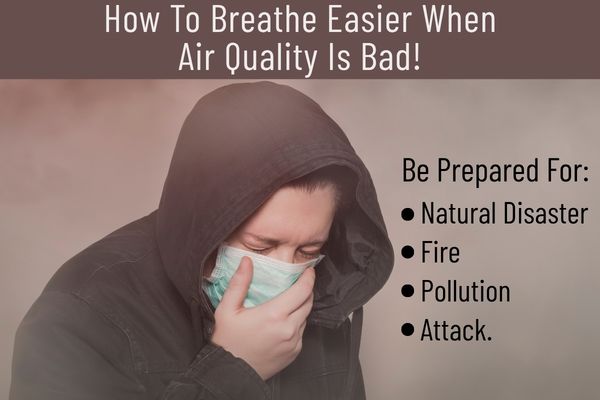
It was a lot worse than Saturday. I walked outside at lunch to go to the gym, and I had a hard time breathing just walking to my car. I was getting COVID flashbacks seeing people walking around in masks.
Whatever we were breathing in, it was something I didn’t want in my lungs. That’s for sure.
It got me thinking about how unprepared I was for a situation like this. I’ll spend so much of my time organizing my pantry, storing water, building a vehicle recovery kit and stuff like that, but I didn’t have anything lined up for an air quality emergency.
The worst of it lasted about 3 days, but the haze and smell lingered for weeks.
I remember hearing that New York had some of the worst air quality readings in the world during that time. And when you take 20,000 breaths a day, that is beyond troublesome.
It Doesn’t Have to Be a Wildfire
I remember watching the news while getting ready for an interview at Publishers Clearing House when I saw the first plane hit the tower. Then the second plane hit, and I watched both towers collapse on 9/11.
My brother-in-law John was in the NYPD at the time, working out of the 113 in St. Albans, Queens. He was on the scene about an hour after it happened and was there for weeks, clearing debris and looking for survivors.
And breathing in all that toxic air.
He is OK, thankfully, but a lot of people died or got horribly sick years later from all the ash and soot in the air at Ground Zero.
There are so many other situations that can affect the air around you. Black mold hidden behind your walls after a leak or flood. A chemical fire at a nearby warehouse, smoke from a house fire down the road or even dust after a tornado.
Last summer, one of the kids in my neighborhood thought it would be a good idea to start a fire pit with gas. It wasn’t. The fumes and smoldering lasted for almost a week before it finally went out.
So, I Built an Air Kit
And it was a lot easier than I thought.
Let me just start off by saying that I couldn’t stand wearing masks during the COVID pandemic. But this is a different animal.
I started out with a decent supply of 3M disposable N95 respirators for my wife, daughter, and me. You can get a pack of 20 on Amazon for less than $16.
There are more expensive ones out there, but I didn’t think I needed to splurge for the Cool Flow Valve feature. They’re more comfortable, but more expensive and not really necessary when you’re only wearing them for a short amount of time.
Here’s where I splurged a little, though, on a portable HEPA air purifier. After reading reviews, I settled on a Tailulu H14 True HEPA Air Purifier and ended up getting two of them for about $75.
You can find other pretty good ones on Amazon for under $25 each.
I have one in the main bedroom and the other in the office on the first floor. I also keep a few extra HVAC filters.
Then just some saline nasal spray, eye drops, an eye wash and a few boxes of tissues. That’s it.
Your Command Center
Mine is the main bedroom. Our whole first floor, with the exception of the office, is wide open. The main bedroom is easy to contain, and it has an attached bathroom.
So, if smoke or poor air quality lasts for a day or two, we can close the windows, shut the door and run the air purifier. Another good trick is to put a rolled up towel under the door.
Older family members, young children and people with asthma may need some extra help getting there.
I also have a decent food supply stashed in the bedroom. You’d be amazed at the places you can store food and water where it can’t even be seen. Super useful if you live in a small apartment, too.
Don’t Forget Your Pets
If the air is bothering me, it’s bothering Muffin, Zippy and Pippy (my dog and cats) a lot more since they have a much better sense of smell than me.
Get those pets into your command center and have some food and water in there for them. A spare litter box and some extra litter is a good idea, too.
Carbon Monoxide Detectors
My dad always called carbon monoxide the colorless, odorless killer.
He was a volunteer in the Nesconset Fire Department for over twenty years. The thing that stuck with him the most was arriving at the scene where a whole family, including two small children, died of carbon monoxide poisoning.
They didn’t have any working carbon monoxide detectors in the house.
I test mine every month or so. I recommend you do the same.
What About Your Car?
When was the last time you changed your cabin air filter?
I just changed mine last week and probably should have done it a few months ago. It’s pretty cheap and it really makes a difference when you’re driving through smoky or dusty conditions.
With all the landscapers blowing dust all over the place in my neighborhood, I should probably do it more often.
Pay Attention to Air Quality Reports
As someone with a horrible pollen allergy, I’ve been doing this in the spring and summer for years. But it’s easy enough to do all year round.
It literally takes ten seconds. I just Google “weather in Nesconset” and “Air quality” is the fourth icon down. 54 today, in the moderate zone.
If I see it’s over 100, the lawn can wait until tomorrow to get mowed.
Most weather apps include the Air Quality Index, and if conditions are poor, I’ll definitely hear about it on News 12 as well.
Final Thoughts
I never imagined I’d be standing on my front porch, looking at a hazy, orange sky, and breathing in smoke from a wildfire burning hundreds of miles away.
But I have to say, in a way, I’m glad it did. Kind of like my first vegetable garden failure, only on a much bigger scale.
I pretty much took the air I was breathing for granted my entire life. Just writing that sounds ridiculous.
Now I have my air kit put together, and I pay a lot more attention to something I never thought twice about before.
Hopefully, another orange sky never shows up over Long Island.
But if it does, I’ll be a lot more prepared than I was the first time.
Anthony Vion is a lifelong prepper from Long Island, NY, who has spent decades building practical self-reliance skills. He writes about everyday prepping in a straightforward, realistic way, with a focus on simple steps that help people stay ready for the unexpected.
This article is for informational purposes only and is not a substitute for professional advice. Always follow guidance from local officials and public health agencies during air quality emergencies or other hazardous situations.