“DAD, the internet isn’t working!”
Every time the Wi-Fi goes out, those five words come blaring out of my daughter’s room, pretty much three seconds or so after it happens.
It’s like the world just came to a grinding halt. Thankfully, the outages generally only last a few minutes. But sometimes it’s for a few hours and that’s when the angry sighing starts. I’m sure I don’t have to tell you what that sounds like.
And God forbid I mention that when I was a kid, there was no internet.
That minor inconvenience changes how most people act, not just my daughter. The internet is instant gratification and when we can’t get that, tempers flare. “What? I can’t find out this second who that actress was in that show I liked in the 1990s? Ridiculous!”
And that’s just for minor disruptions. So, how in the world will we survive if we lose the internet for a few days or dare, I say it out loud, a few weeks or even longer?
No weather updates, no GPS, no streaming, no looking up recipes, no paying bills online, no nothing. We spend so much of our time online that we don’t even realize just how dependent on it we’ve become.
And there doesn’t have to be a massive disaster, although that would do it, too. A major storm rolls through and takes out local service. Your provider has an outage, or worse, gets hacked.
Or a construction crew on your block cuts a fiber line. That one actually happened to me last year and we were without internet for three days.
So how do you prepare for when your phone becomes totally useless? It’s pretty simple, really. Let’s get to it.
Download Offline Maps … Before You Need Them
Hands down, I think I may have the worst sense of direction in the world. Sometimes I’ll get detoured and think I’m heading in the right direction and end up miles out of the way. In my own neighborhood. My daughter loves that too when she’s with me.
Most of us rely on GPS so much that we barely think about directions anymore. And even if you know how to get someplace, a detour can throw a monkey wrench into your plans real fast.
I remember before we got married, my wife printed out directions from MapQuest when we went away for the weekend to the Poconos. OK, OK, it was 1998. Phones weren’t what they are now, and we didn’t have that old school GPS system yet either. It was a Garmin, remember those?
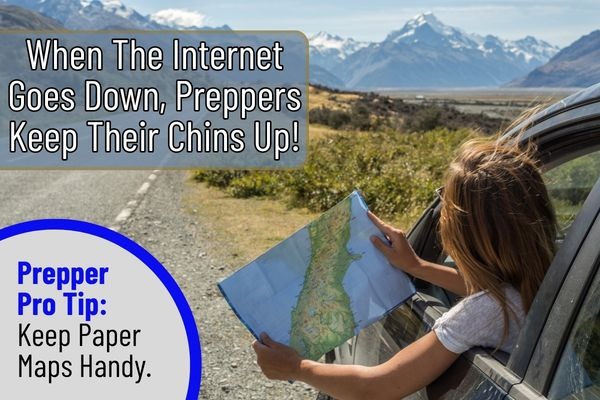
Can you imagine navigating with a paper map? We’ve done it before, so what’s so hard about doing it again? And even if you haven’t done it before, you’ll be happy to have the option.
I have maps downloaded and printed out for my town and surrounding areas, routes to major hospitals and relatives’ houses, evacuation routes, and even directions to friends’ houses in neighboring states.
You may want to also have maps for places you go a lot, hiking or camping areas and things like that.
I get weird looks sometimes, but I always have a road atlas in the glove compartment of my Prius.
The Prepper Disk comes in pretty handy here, as well, if you have one.
Save Important Documents Locally
In the past, I’ve been guilty of going to the app for my medical insurance ID card, car insurance proof and other important documents.
I smartened up though and now have pretty much everything I need downloaded to my Dropbox app so I can get to it when I can’t get online. Makes life a lot easier.
Think about what else you may need. Medical records, copies of ID, prescriptions, emergency plans. Even things like warranties could be helpful.
You can save copies right to your computer or put them on a USB drive if you think you’ll need to grab and go.
Call me old-school, but I also print the critical documents and keep them organized in a binder.
Keep Emergency Contacts On Paper
This used to be normal. Funny, right?
I found an address book a few weeks ago when cleaning out some drawers that had the names, addresses and phone numbers of everyone we knew at the time.
Along with a terrible sense of direction, I also don’t have the best memory. I think I know maybe five or six phone numbers by heart.
Don’t look at me like that. If your phone dies and you can’t charge it, how many numbers would you be able to dial off the top of your head?
I recently created an updated list with the numbers of my immediate family, a few neighbors, doctors, Costco and CVS pharmacies we use, the vet, local emergency services, school contacts, AAA roadside assistance and utility companies.
There’s a copy in my wallet and in my emergency binder. You can keep one in your car too just to be safe.
Use Actual Cookbooks
You don’t need a time machine to go back to your grandma’s kitchen. If you don’t have a physical cookbook, they still print them. I have two in the house, plus some handwritten recipes of my nana’s.
When the internet is down, you don’t want to be guessing how long to cook that chicken and at what temperature, either.
Last year I started to make my own potato wedges. I must have made them at least ten times but still find myself Googling how long to keep them in the oven.
So, I Googled it one last time and finally wrote it down. 425°F for twenty-five minutes. They’re not quite chips, but I do cut them thin.
You’ll probably find a few new favorites, too.
Entertainment Without Streaming … What?
It’s a thing, really. But it may take a little work convincing the kids about that.
Who am I kidding. Adults are pretty much the same. Netflix, Amazon Prime, Hulu, Disney+, this +, that +. Even my mom who is 76 is always streaming something when I stop by.
But when the internet goes down, you’re going to need options.
Monopoly is banned in my house because of all the fighting it causes. We are a ruthless bunch. But we do break it out at times like these. Other board games, too.
We’re bigger on card games though, with Uno being the top choice. But a regular pack of playing cards can bring hours of entertainment with poker, gin rummy, war and even old maid.
And don’t forget about puzzles. With a 1,000-piece puzzle, that’s hours of entertainment right there.
My wife only reads physical books and is at the library at least twice a week. So, she is always prepared.
There are plenty more hobbies and crafts that you don’t need to go online for. But if you feel you absolutely need to fill the streaming void, downloaded movies will help get you by.
Have Some Cash On Hand
Wherever I’m checking out, it’s always swipe or tap. I did see someone paying with cash at the grocery store last week. It was nostalgic.
When internet outages are widespread, those credit card machines aren’t going to get you what you need. I take a page out of my dad’s playbook and always have cash in the safe. Not a ridiculous amount like he did but usually a few hundred bucks.
You never know when you’re going to need it. I try to have a mix of smaller bills as well.
Test It Out One Night
That’s right, turn off the Wi-Fi for a few hours … on purpose.
Have a checklist ready so you don’t forget anything. Can you call your cousins if you need to get in touch with them? Try driving to one of your favorite places but not taking your normal route. Any problems getting there?
See if any issues come up while cooking dinner. What entertainment do you have around? Is there any vital information you may need but can’t get to?
It’s a good eye-opener.
Final Thoughts
Losing internet may be one of the easiest things to prepare for because you really only have to do it one time and you’ll be ready every time.
It’s not expensive or complicated. It’s just putting a few simple backups in place.
I’ve dealt with enough outages over the years to know how fast a house can go from normal to “DAD!”
Go through your phone and write down those phone numbers. Put some cash in the safe or in a safe place. Spend a few minutes downloading maps, dusting off the board games and playing cards, and finding that old cookbook you haven’t seen in years.
The Wi-Fi going out for ten minutes is annoying. A few days is a different animal.
And the next time the internet cuts out and somebody yells from upstairs, at least you’ll know you’re ready for it.
BIO: Anthony Vion is a lifelong prepper from Long Island, NY, with decades of hands-on experience in self-reliance and practical skill-building. He writes about everyday prepping in a straightforward, realistic way, with a focus on simple steps that help families stay ready for the unexpected.
This article is based on personal experience and is intended for general informational purposes only. Every household is different, so use your best judgment and prepare based on your own needs and situation.