Over the last 30 years or so, I’ve heard tons of statistics about non-verbal communication. My nephew, Tristan, works on a road crew and he’ll tell you it’s over 90%. His father, Dave, is a teacher and he just shakes his head at that stat. But Dave’s reaction is pretty telling, right?
My wife has this look she gives me when, let’s just say she’s displeased with what I’m doing. Like when she throws a banana peel in the kitchen garbage and I casually scoop it out. What can I say, I’m a hardcore composter.
She doesn’t have to say a word, and I know exactly what she is saying. “Can’t you just let it go?” There’s generally a head shake involved, too, but not always.
When I feel like pushing buttons, I tell her, “You know, you’re one heck of a tactical communicator.” This often gets greeted with an about face and exit stage left. Or once in a while, just closing her eyes and taking a deep breath.
“You are an idiot.” But in a playful way. Listen, we’ve been married over 26 years, so I know.
Body language, hand gestures, facial expressions, and eye contact all give critical information. You just have to know how to read them.
This gets ratcheted up into high gear during emergency situations when you can’t be heard or, in some cases, don’t want to be heard.
I’ve seen people, my neighbor Paul being one, spend hundreds of dollars on radios, tactical headsets, and communication gadgets, but never sit down with their family to discuss a simple emergency communication plan.
I’m not talking about complicated tactical training. Just practical communication strategies that help families, neighbors, hunting partners, and communities work together when it hits the fan.
Could be a natural disaster, a prolonged power outage, neighborhood security patrols, or simply getting around safely in the outdoors with a team.
You all have to be on the same page. No assumptions.
Why Assumptions Are Dangerous
One of my favorite episodes of The Odd Couple was where Felix was talking about the word, “Assume.”
“What happens when you assume?”
Ass-u-me
“You make an ass out of you and me!”
I can’t help but still laugh when seeing it, but in a dangerous situation, making an assumption doesn’t just make you look silly. It could be life-threatening.
I’m guilty of this sometime. I think everyone knows what’s in my head and where I’m going with something.
You have to be specific. If a storm is coming, you can’t just tell your family to “get ready.”
To my daughter, that would mean to charge her phone and laptop. To my son, I honestly don’t know what that would mean.
You want crystal clear communication. Fill the water bottles, check the flashlights, get the candles from the basement. Find the emergency contact list.
Or if all of a sudden that message flashing across the TV from the Emergency Broadcasting System isn’t just a test this time. You have to get out of your house fast.
Does everyone know where you are meeting in case you get separated? What is everyone’s job? Food, water, meds, pets, important documents. There is no time to assume who is doing what.
The instructions and responsibilities have to be clear. And everyone has to know them before they need to. But prepping for emergencies is part of tactical communication.
Radios Are Great, But…
I remember having a set of walkie talkies when I was seven or eight. I had one and my best friend, Sean, had the other.
It would be like 7:30 p.m. on a school night and I would try to reach out to him, using that cool “Over” language. Nine times out of ten I would get no response. Either he didn’t have his with him or he didn’t have it on.
Well, same story for radios. If everyone is carrying them and oh yeah, if the batteries aren’t dead, they’re great. But they also break, get lost in the chaos and are useless if they get caught in the floodwater.
Even if the stars align, you don’t want to be using a radio when you’re on a hunting trip deep in the woods. Or in a home defense situation or any other scenario where silence is more than a virtue.
Vital Hand Signals
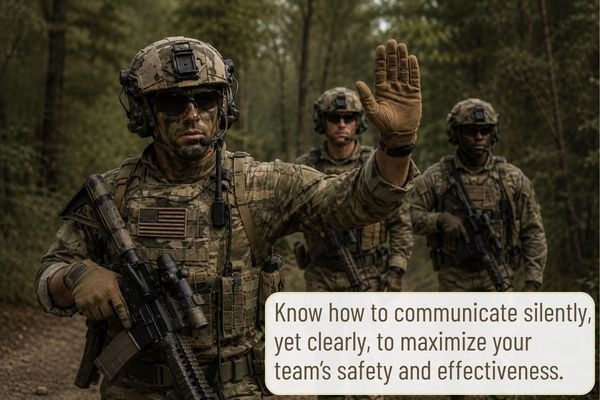
Staying unseen doesn’t just mean camouflage.
Being able to communicate silently with your group can be essential at times. But you don’t need a playbook or complicated baseball manager signs.
My eighth-grade math teacher, Mrs. Madonia, had an acronym for some math subject that I long forgot, but I still use the acronym today for other things, especially hand signals.
KISS – Keep It Simple, Simon. OK, I edited that. It was Keep It Simple, Stupid.
Keep the signals to a minimum and there’s less of a chance for miscommunication and making a dangerous situation worse. Honestly, you probably already know these. The big ones are:
Stop.
Just a closed fist raised in the air when you notice danger or want the group to hold up.
Come here.
Move your fingers towards yourself with your hand in the air.
Move this direction.
Sweep your arms in the direction you want the group to go.
Potential threat.
Point clearly towards the direction. I like placing a finger to my lips as well for this one.
All clear.
A thumbs up showing all that everything appears safe.
You want to communicate quickly, reduce confusion, keep everyone working together and stay unseen.
Thumbs up.
Other Discreet Signals
You see this one in the movies all the time, but I’ve used it before and it definitely works.
Either a short whistle or a bird call. I’m not talking about an NFL whistle. Just put your lips together and blow twice quickly. Just make sure your group is aware of the signal beforehand.
Some people like flashlight signals, but what good is that when it’s daytime. I’m not a big fan even in the dark as the person or persons you are trying to stay away from can clearly see it.
It sounds almost too simple, but if you’re close enough, facial expressions are great. Nothing says “pay attention” better than a raised eyebrow.
My wife has an entire communication system based on facial expressions alone. I wouldn’t count on something like that for a larger group though, especially since most of those looks are geared towards me.
If you’re within touching distance, a tap system could work great. One tap for stop, two taps for go. I actually used this one on a hiking trip in Maine with my friend, Andrew, when a fog came out of nowhere and hung around for almost an hour.
Teamwork Makes the Dream Work
Part of me wants to punch myself in the face just for writing that. But in this case, it’s fitting.
I’ve always been part of or led teams where communication was the number one priority. When you share information, understand goals, have clear direction and can adapt when situations change, you’re always going to achieve the best outcome.
Get everyone on board early. Go over the plan, the signals, what to do if you get separated, who is responsible for what. You’ll thank yourself later.
Final Thoughts
After more than 26 years of marriage, my wife and I can have entire conversations without saying a word.
A look. A head shake. A raised eyebrow. I know exactly what she’s thinking. Most of the time, anyway.
That didn’t happen by accident. It came from years of paying attention, understanding each other, and learning how to communicate clearly.
Getting that set up with a team is very similar. It takes more effort, but it’s worth it for sure.
Because when a hurricane is bearing down, floodwaters are rising, the power is out, or your family is scrambling to evacuate, an expensive radio or tactical gear isn’t going to fill you with confidence.
What will keep you strong is everyone knowing the plan. Your daughter knows where to go if you get separated. Your son remembers to get all the meds for the family. Your wife gets all your important documents, including the emergency contact list. Oh, and Muffin … my wife doesn’t forget our dog, Muffin.
Everyone needs to communicate, even when normal methods aren’t going to work.
That’s the heart of tactical communication and why it’s so important.
It’s the thread that ties all the others together.
About the Author: Anthony Vion is a lifelong prepper from Long Island, NY, with decades of hands-on experience in self-reliance and practical skill-building. He writes about everyday prepping in a straightforward, realistic way, with a focus on simple steps that help families stay ready for the unexpected.
This article is based on personal experience and is intended for general informational purposes only. Every household is different, so use your best judgment and prepare based on your own needs and situation.